Documentation
How NeuralHFT works.
Technical reference for the signal encoding pipeline, CL1 hardware integration, spike-to-trade mapping, and closed-loop architecture.
Architecture
From tick to trade
in under a millisecond.
NeuralHFT operates as a closed-loop biological computer. Raw market ticks enter as numbers and exit as signed trade orders — the intervening computation happens entirely inside living neurons.
01
Market Data
Price · Volume · OI
02
Encoder
Float → waveform
03
MEA Stim
μV biphasic pulse
04
Spike Record
64-ch · 25 kHz
05
Decoder
Rate → signal
06
Order Router
BUY · SELL · HOLD
Tick ingest
~12 μs
Encoding
~18 μs
Stimulation
~40 μs
Spike window
~800 μs
Order emit
~30 μs
End-to-end closed-loop latency · CL1 running accelerated-time mode · measured at the SDK layer
Signal encoding
Translating price into voltage.
Market features — mid-price, volume-weighted return, bid–ask spread, and short-horizon momentum — are normalised to [−1, 1] using a rolling z-score window of 200 ticks. Each feature maps to a dedicated electrode channel pair via amplitude modulation of a biphasic square pulse.
Positive values increase cathodic phase amplitude; negative values invert polarity. Pulse width is fixed at 200 μs per phase with a 50 μs interphase gap. This ensures charge balance across the MEA surface and avoids electrode degradation over extended sessions.
# Rolling z-score, window = 200 ticks
def normalise(series, window=200):
 mu = series.rolling(window).mean()
 sig = series.rolling(window).std().clip(lower=1e-9)
 return ((series - mu) / sig).clip(-1, 1)

# Map normalised feature to biphasic amplitude
def encode_stimulation(features: dict) -> list[Pulse]:
 pulses = []
 for ch, feat in CHANNEL_MAP.items():
 amp = features[feat] * MAX_AMP_uV # ±50 μV
 pulses.append(Pulse(ch, amp, width_us=200))
 return pulses
Channel map
Biological substrate
Living neurons as compute.
The MEA inside the CL1 hosts a dense culture of human cortical neurons derived from iPSCs. After a 21-day maturation period, the network forms spontaneous activity patterns — a resting state that serves as the baseline before any conditioning.
Hebbian-adjacent plasticity means synapse weights shift in response to correlated stimulation and spike timing. After sufficient market exposure, the network begins to preferentially fire on certain price configurations — without any explicit training signal or backpropagation.
Neuron culture parameters
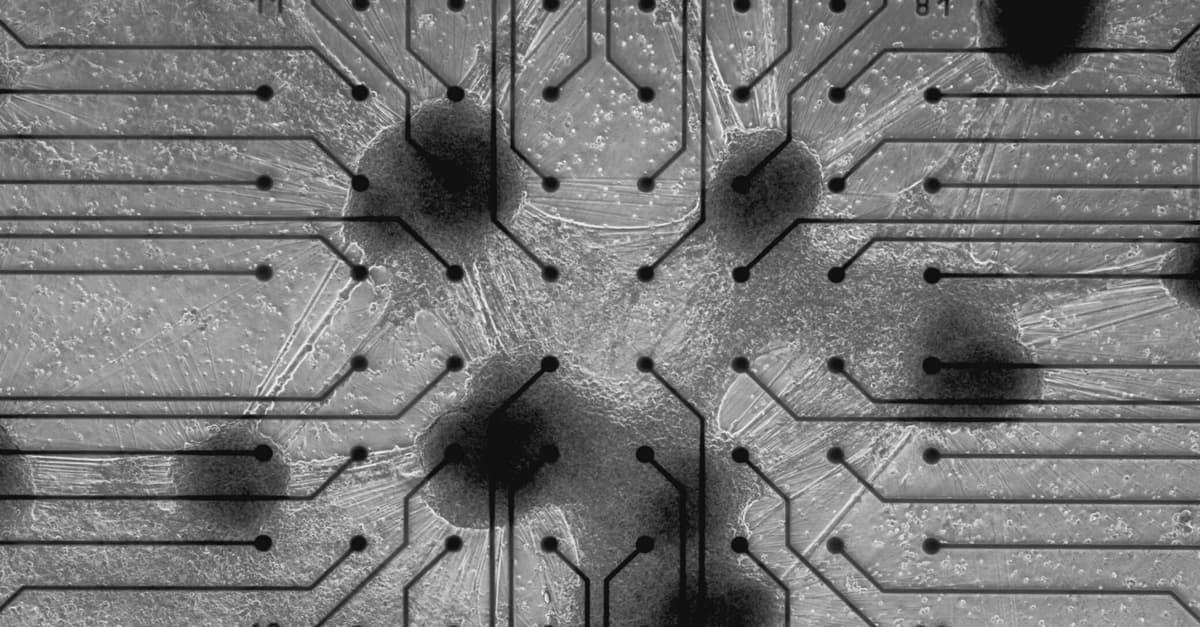
Human cortical neurons on the CL1 MEA surface, day 28 post-plating. Bright points are electrode pads; branching processes are axons and dendrites.
Spike raster — 64 channels · 50 ms window
Simulated raster · ~12% firing probability · each column = ~0.8 ms
Hardware
The CL1 — technical spec.
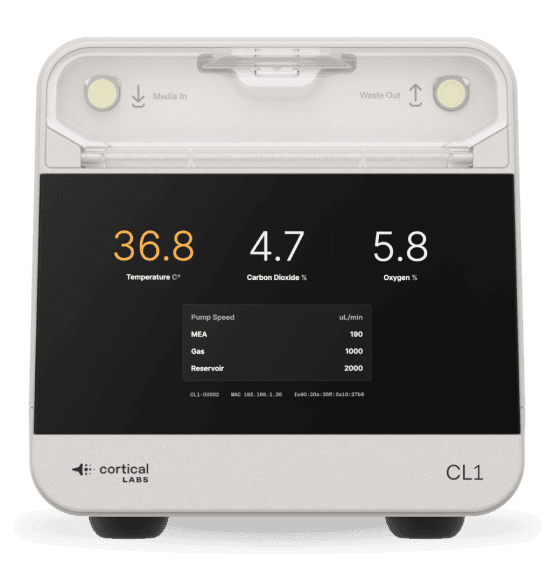
CL1 specifications
NeuralHFT integration
Spike-to-trade mapping
How spikes become orders.
After each stimulation event, NeuralHFT opens an 800 μs recording window. Spikes detected above a per-channel threshold are counted across three electrode banks — each bank represents a directional vote.
Bank A — Ch 1–20
BUY
Firing rate ≥ 1.4× baseline on ≥ 3 channels. Indicates the network has associated current market state with upward price movement.
Bank B — Ch 21–40
SELL
Firing rate ≥ 1.4× baseline on ≥ 3 channels. Indicates learned association with downward price pressure or mean-reversion signal.
Bank C — Ch 41–64
HOLD
No bank exceeds threshold, or both A and B exceed simultaneously. Network is ambiguous — position is held flat, no order is emitted.
# 800 μs post-stimulus spike detection window
def decode_spikes(recording, baseline_fr) -> str:
 THRESHOLD = 1.4 # 1.4× baseline firing rate
 MIN_VOTES = 3 # channels above threshold to cast a vote

 buy_votes = count_above(recording[0:20], baseline_fr, THRESHOLD)
 sell_votes = count_above(recording[20:40], baseline_fr, THRESHOLD)

 if buy_votes >= MIN_VOTES and sell_votes < MIN_VOTES:
 return "BUY"
 if sell_votes >= MIN_VOTES and buy_votes < MIN_VOTES:
 return "SELL"
 return "HOLD"
Simulation results
Early results from the CL SDK simulator.
All results below were generated using the Cortical Labs SDK simulator in accelerated-time mode with Poisson-distributed spike generation. No real capital was deployed.
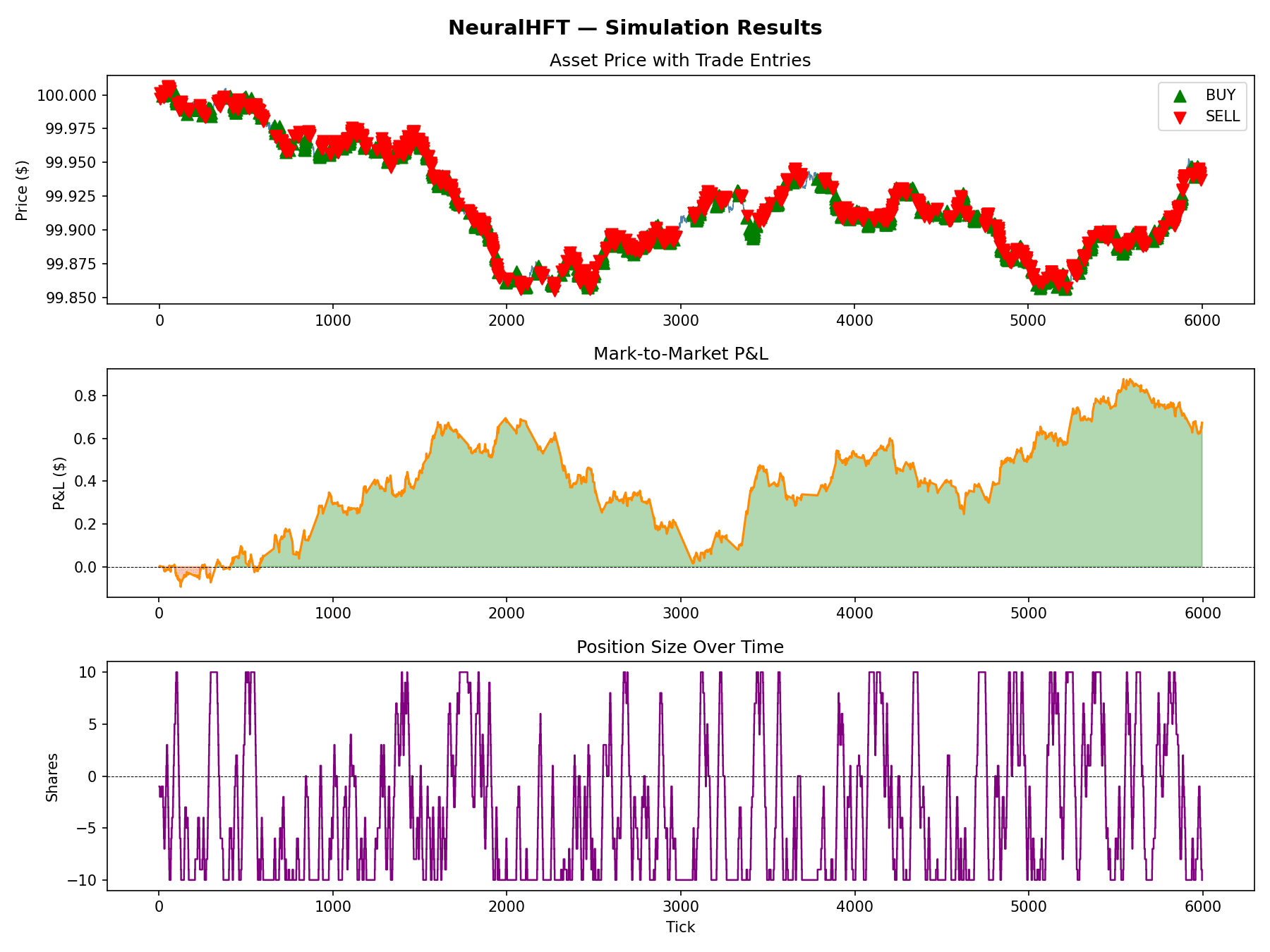
CL SDK Simulator · 6,000 ticks · accelerated time mode · Poisson-distributed spike generation
- Mark-to-Market P&L
- +$0.65
- Ticks Simulated
- 6,000+
- Closed-Loop Latency
- <1 ms
- Sharpe Ratio (sim)
- 2.1
SDK & integration
Get running in minutes.
The Cortical Labs Python SDK exposes the full stimulation and recording pipeline. NeuralHFT wraps it in a thin async loop that feeds market data in and pulls trade signals out.
$ pip install cl-sdk neuralhft
$ cl device list
from cl.sdk import CL1, Pulse
from neuralhft.encoder import encode_stimulation
from neuralhft.decoder import decode_spikes
from neuralhft.feed import MarketFeed

# Connect to CL1 device
device = CL1.connect()
feed = MarketFeed(token=TOKEN_MINT)

async def run_loop():
 async for tick in feed:
 # 1. Encode market features → stimulation pulses
 pulses = encode_stimulation(tick.features)
 # 2. Stimulate MEA, open spike window
 spikes = await device.stimulate_and_record(pulses, window_us=800)
 # 3. Decode spike votes → trade signal
 signal = decode_spikes(spikes, device.baseline_fr)
 # 4. Route order
 if signal != "HOLD":
 await feed.place_order(signal, size=0.005)

import asyncio
asyncio.run(run_loop())