Research
The network inside
the GPU the petri dish.
Why biological neural networks outperform silicon on adaptive, low-latency inference — and how NeuralHFT puts them to work at market speed.
The core insight
Silicon computes. Neurons adapt.
Traditional artificial neural networks are mathematical approximations of biological ones — static weight matrices that require offline retraining whenever the environment shifts. A transformer doesn't rewire itself because the market regime changed. A biological neuron does.
Real neurons modify their synaptic weights continuously through spike-timing dependent plasticity (STDP) — a Hebbian-adjacent process where firing correlation strengthens connections and anti-correlation weakens them. No gradient. No loss function. No retraining pipeline.
01
No retraining
The network adapts continuously in-session. Regime shifts that break ML models are absorbed as new synaptic configurations over minutes, not retraining cycles.
02
Native parallelism
64 electrodes fire simultaneously. The biological network performs massively parallel inference on every tick — no sequential matrix multiplication required.
03
Sub-ms response
Neurons respond to stimulation in under 800 μs. The total closed loop — encode, stimulate, spike, decode — completes in under one millisecond.
Network topology
A recurrent network that wires itself.
Unlike a feedforward ANN — where data passes left-to-right through fixed layers — the biological network inside the CL1 is densely recurrent. Outputs feed back as inputs. Temporal context is encoded in the ongoing firing state of the network, not in a separate memory module.
The diagram shows a simplified analogue: input nodes (left) map to market features delivered via electrode stimulation; the dense middle layers are the MEA culture itself; output nodes (right) correspond to the electrode banks that decode trade direction.
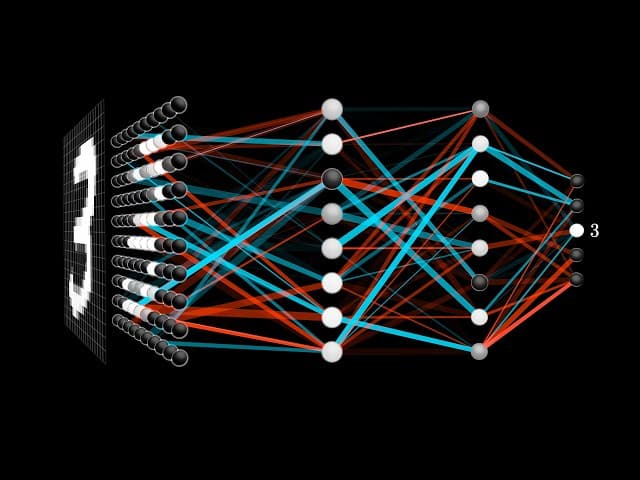
Conceptual representation of the CL1 network. Blue connections indicate excitatory pathways strengthened by correlated firing; red connections indicate inhibitory or weakened synapses. The biological implementation has ~10⁸ connections vs. the ~200 shown here.
Learning mechanism
Hebbian plasticity, not backprop.
Backpropagation — the algorithm underlying virtually all deep learning — requires a differentiable loss function, a forward pass, a backward pass, and a weight update step. For a high-frequency system, this is prohibitively slow. It also requires you to know what the "right answer" is before updating, which you don't in live markets.
STDP sidesteps all of this. If neuron A fires just before neuron B, the synapse A→B strengthens. If B fires before A, it weakens. Over thousands of ticks, the network self-organises around the statistical structure of the market without any explicit supervision.
STDP weight change vs. spike timing Δt
LTP = long-term potentiation · LTD = long-term depression · τ ≈ 20 ms
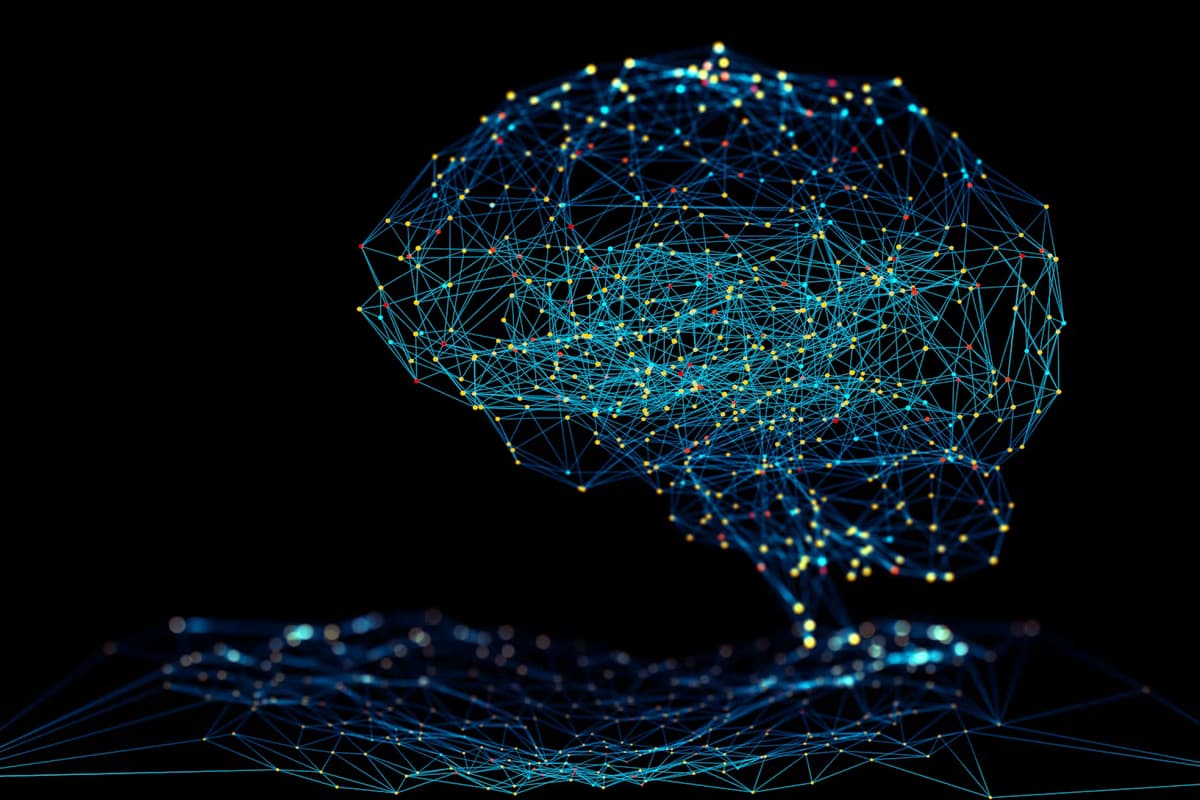
Confocal imaging of a cortical neuron network. Each branching structure is a dendrite; synaptic contact points number in the thousands per cell and change strength continuously.
STDP vs. backpropagation
Speed
Why biology wins on latency.
A GPU-based inference pipeline for a comparable model involves data serialisation, CUDA kernel launch overhead, memory transfers, and framework dispatch — each step adding microseconds that compound. Biological neurons skip all of it. Stimulation reaches the membrane in nanoseconds; the action potential propagates in microseconds.
The CL1's closed loop samples at 25,000 Hz — one complete stimulate-record cycle every 40 μs. Even accounting for the 800 μs spike integration window, the full encode → stimulate → decode pipeline completes in well under 1 ms, a threshold no GPU inference stack in production reaches today.
End-to-end inference latency — log scale
Values are approximate · GPU figures exclude data I/O and model loading
Spike latency
< 1 μs
Membrane to AP
Sampling rate
25 kHz
Per channel
Spike window
800 μs
Post-stimulus
Full loop
< 1 ms
Encode → order
vs. traditional ML
Head-to-head.
The advantage of biological compute isn't just speed — it's the combination of speed, adaptability, and zero inference cost that no silicon architecture simultaneously achieves.
| Metric | NeuralHFT (Biological) | Traditional ML / ANN |
|---|---|---|
| Inference latency | < 1 ms | 4–60 ms |
| Retraining required | Never | On regime shift |
| Online adaptation | Continuous (STDP) | Not supported |
| GPU dependency | None | Required |
| Compute cost per inference | Near zero | Proportional to params |
| Model interpretability | Low | Low–Medium |
| Reproducibility | Stochastic | Deterministic |
| Scalability | Single device | Horizontal scale-out |
| Energy per decision | ~10 nW | ~1–10 W |
Biological figures measured on CL1 hardware · ML figures representative of production PyTorch/TensorRT deployments